Dandy Flats: Thomas, WV

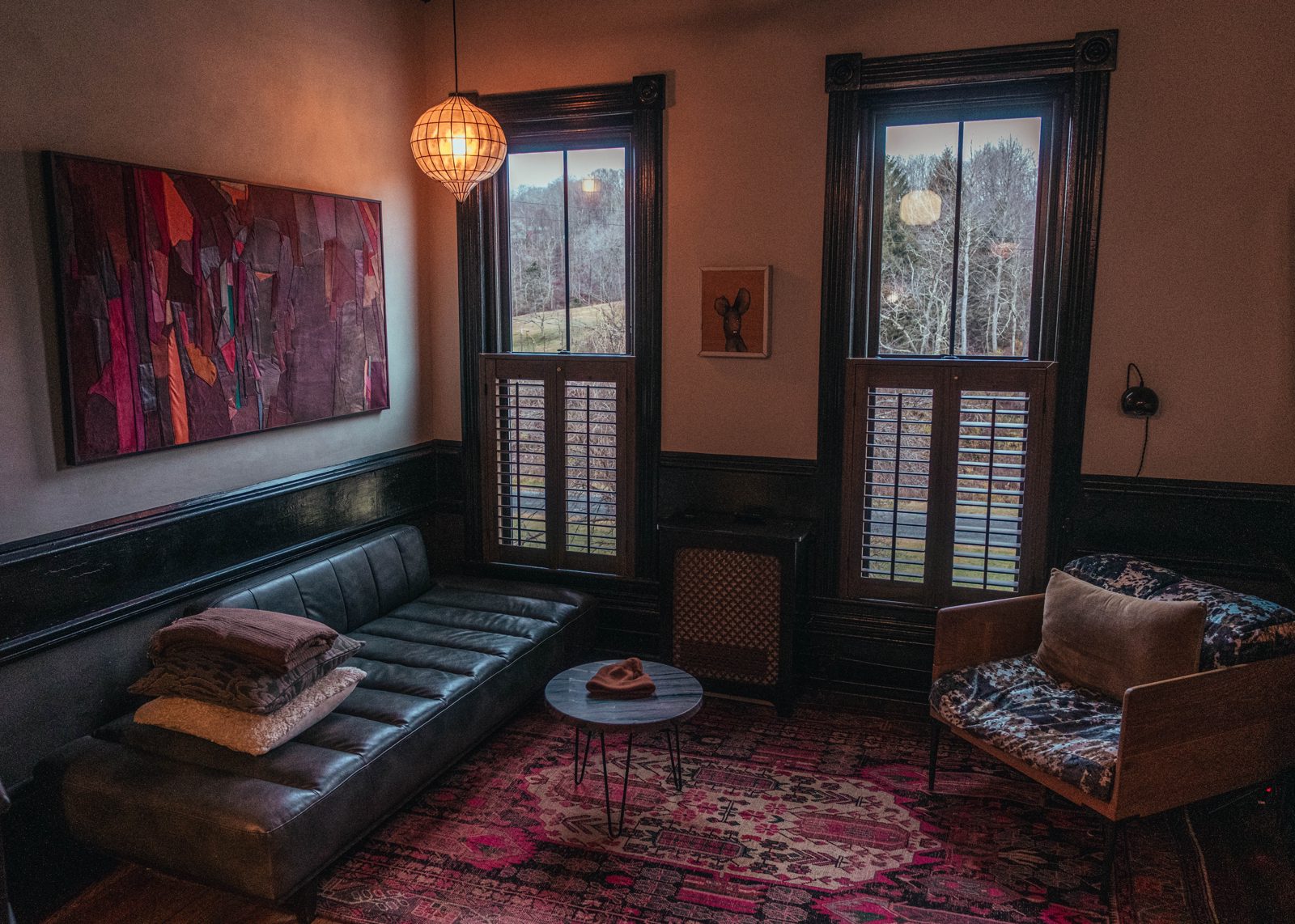
What Dandy Flats wants from its guests is something different than your average hotel room or even nice Airbnb: admiration. Every detail in these apartments, from the bathroom tilework to the rich floral kitchen wallpaper to the artwork to the mood-setting lamps, has clearly come at the cost of much sweat.

The result is extremely cool without being pretentious or precious. In fact, it’s so well done, the temptation is to pick it apart for signs of that it’s been overdone, that it does venture into inhospitable preciousness. But, no, it’s just a very comfortable space. As much as it wants your admiration, Dandy Flats wants you to chill.
Dandy Flats, and the blood and sweat that’s gone into it, is also a tremendous bet on its environs: the tiny arts enclave of Thomas, West Virginia.
In a few years time, those environs will have both an expressway and a 10,000-acre data-center development on its Canaan Valley doorstep. A light-industrial megaplex sprawled out there in the woods, groaning and humming and sponging LED floodlighting across the night sky—a brand-new city to dwarf its small-town neighbor certainly not in population, but in power consumption, noise, and light. And at its flank: a brand-new superhighway.
The data center and expressway are state-level impositions. The prior is a consequence of a recent law, HB 2014, that gives the state sole authority to certify new data center projects, essentially gilding the approval process in what’s already touted as the most regulation-free jurisdiction in the United States.
The premise, as is always the case in this beleaguered state, is jobs and revenue. The promise is a return to pax West Virginia, a 50-odd year period of hydrocarbon boomtimes that ended around 1960, as coal demand/labor demand plummeted thanks to automation and a movement toward alternative energy sources, like oil.
There are hundreds of little towns in West Virginia that could be Thomas with the right proximity to Washington, DC and its money. Instead, a great many of them—towns founded a century ago and built to last hundreds of years—are empty and overgrown. These are places that, in the grand scheme, barely had time to be built out before being returned to nature as mounds of broken glass and masonry.
Yet, here in the Eastern Panhandle, surrounded by the mountains of Monongahela National Forest, we have revitalization. Tucker County, home to Thomas and Davis, didn’t go the other way. To a local native, these are probably just the cursed words of a weekender praising mountain-town gentrification. But, trust me, as a Colorado native, it gets much, much worse than this. Thomas, after all, is mostly just a single rehabbed main street of galleries and shops, capped at one end by a bluegrass bar. If there’s any significant new construction around here, it’s very well hidden.
What does a massive industrial project do to a town like Thomas? No one knows, and it seems virtually no one here wants to find out, judging by the ubiquity of anti-data center signage. Everything in Tucker County suddenly feels a little more fragile though. For better or worse, a place like this depends on people from outside wanting to come here.
Dandy Flats has been a work-in-progress since 2014. It’s a rehab—a “self-built restoration and adaptive reuse effort”—of an 1885 building that once housed a pharmacy, doctors’ apartment, office, operating room, and co-ed social club.
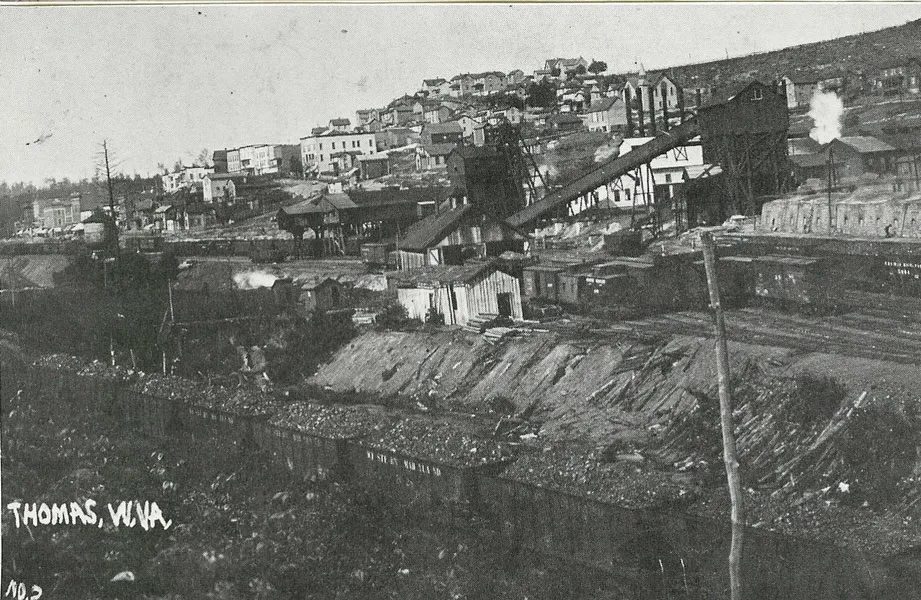
At that time, during the area’s first industrial boom, Thomas existed for coal and coke, a processed coal byproduct. By 1906, Davis Coal & Coke owned 100,000 acres of coal-producing land that yielded 8,000 tons per day. The nearby coke ovens of Coketon were said to light up the sky like the aurora borealis, according to a history in the Parsons Advocate. You could see it for miles around.
Booms have an end, of course, and the end of the coal and timber boom in Tucker County was apocalyptic. Simply, the resources ran out, leaving behind a wasteland devoid of trees and pocked by abandoned coal mines and coke ovens (some are still intact near Thomas). The miners and loggers left, and the railroad pulled out. Naturally, the businesses on Front Street shuttered with them.
“We had a bunch of artists and stuff move into town and bought these buildings,” Jody Flanagan, the mayor of Thomas, recalled in a Brookings podcast in 2023. “Empty buildings was on Front Street and they started repairing them and making them nice, starting their own businesses.” That would have been in the early-2000s.
“And there’s some really talented people that live down here and operate these businesses on Front Street,” Flanagan said. “Most of the people that own these buildings and stuff down here and in Thomas now are younger group of people. So, that’s really what brought the town back. It’s really what brought us back to where we are now at the present time.”
There’s a lot more to it, of course, with government grants, local sales taxes, and nonprofit development corporations. It’s an interesting story that really reduces to the right people caring enough at the right time.
To be sure, Tucker County has an affordable housing problem. Airbnbs have a big impact on housing supply in a town of 600 people. (Dandy can be booked on Airbnb, but it has its own booking site as well.) That said, unlike in say Aspen or Telluride, affordable housing is solvable at this scale.
Ultimately, it seems like Tucker County should be a model for West Virginia revitalization. The whole jobs and revenue issue. Given the alternative (no jobs, no revenue), housing is a good problem to have.
West Virginia is a state fixated on the past, perhaps more than any other I can think of. And in the past, natural resources were something to be industrialized, as quickly as possible. If there are lessons from that in this now-depopulated state, they go often, if not mostly, unlearned.
-- michael byrne